An RFI is rarely a hard question. It is a simple question that arrived without the context needed to answer it: which wall, which elevation, which version of the detail, and what is actually installed right now. The cost is not the answer — it is the delay, the meeting, the extra trip, and the change order written while everyone waits.
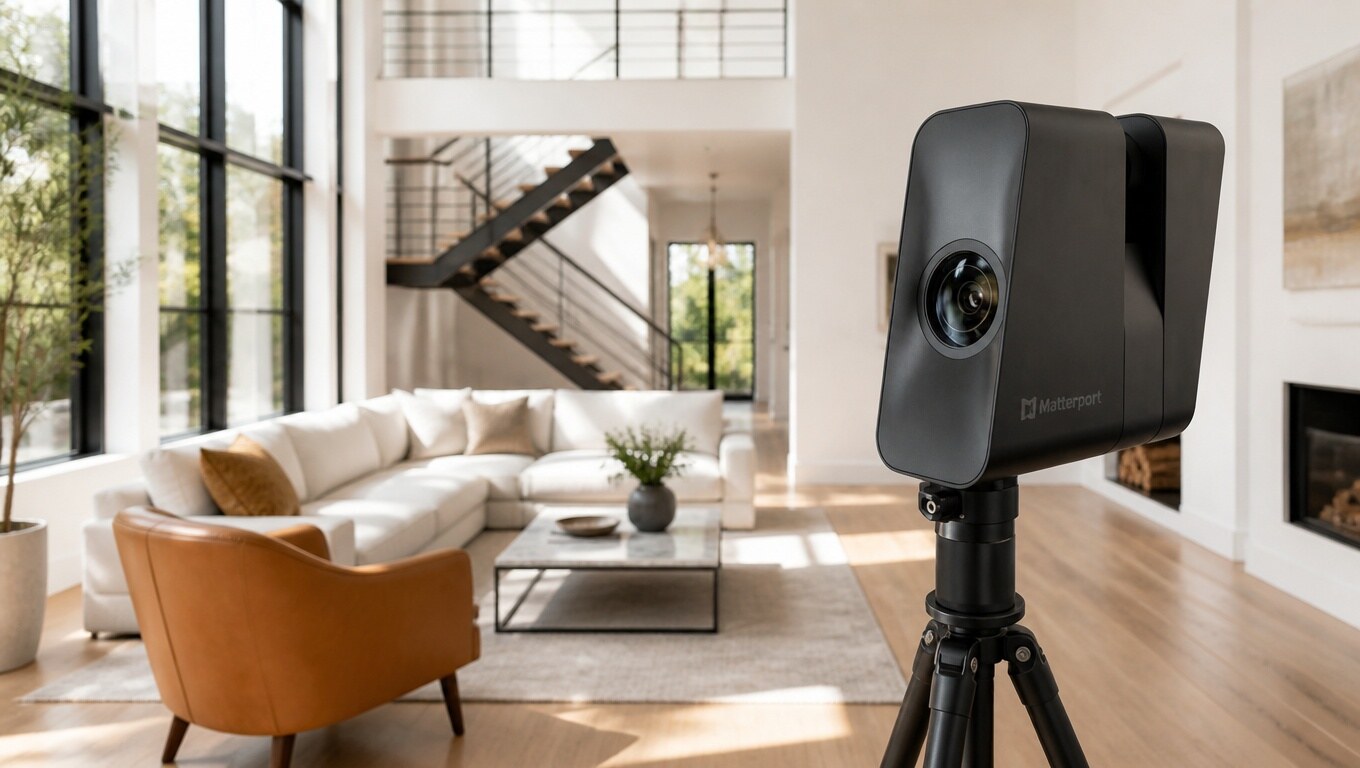
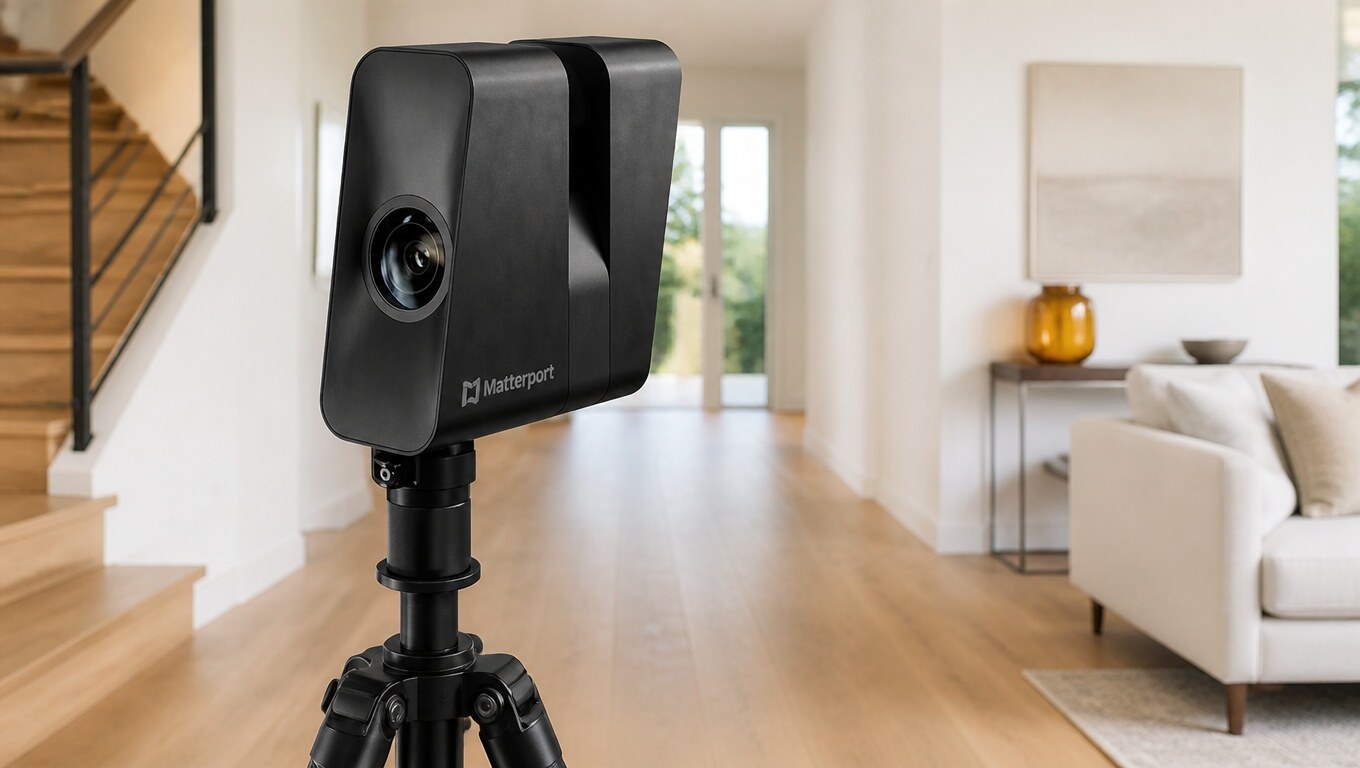
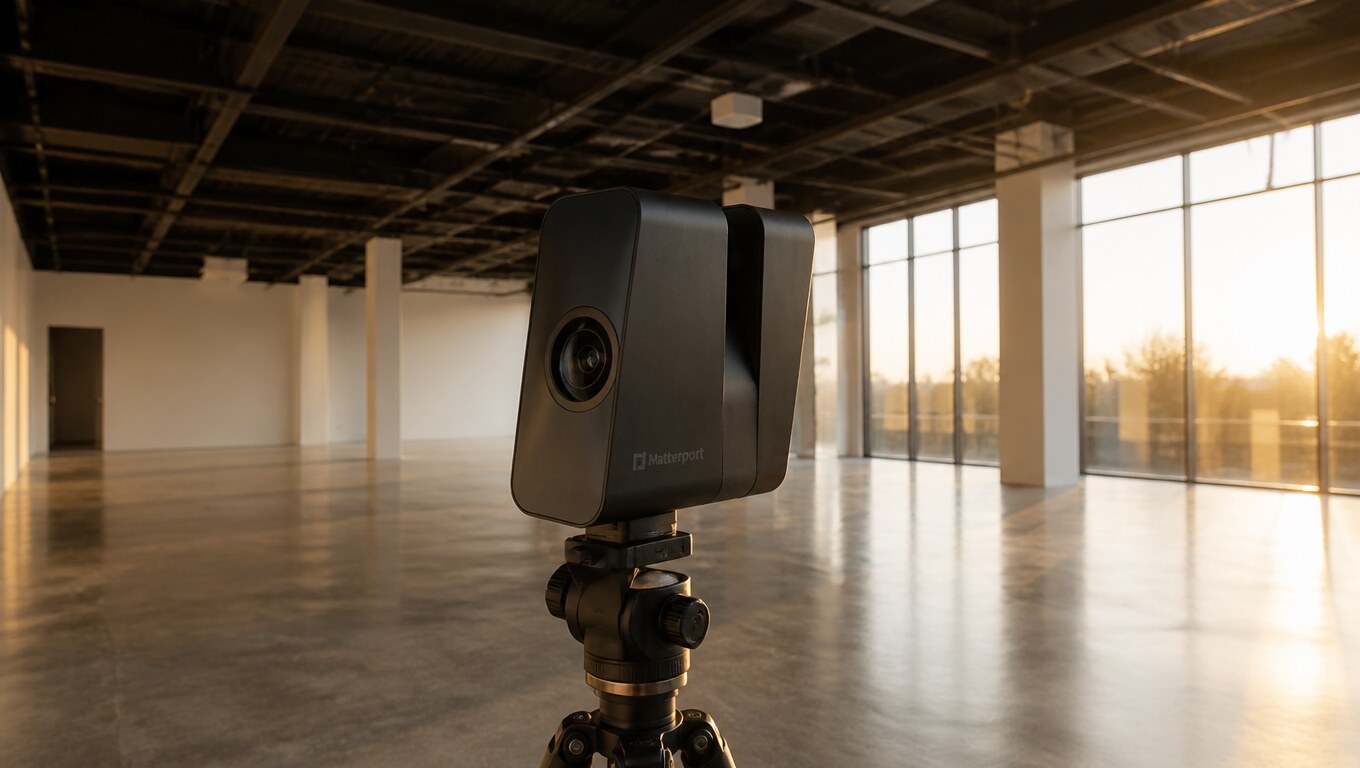
Matterport 3D tours remove most of that pipeline. Invision Studio’s Matterport 3D tour photographers capture new builds on a scheduled cadence with the Matterport Pro3, so the site is always available as a navigable, measurable record instead of a folder of photos somebody has to interpret.
Key takeaways
- Most RFIs are context problems. Give the whole room, the measurements, and the date, and the question often answers itself.
- Remote review is not a compromise. At roughly ±20 mm at 10 m, the Pro3 lets teams check clearances without sending anyone to site.
- Faster answers mean fewer change orders — decisions made before a trade mobilizes never become back-charges.
- Builders report real savings: about 75% of issues resolved without escalation, and 25–30% less time and cost on documented design-build programs.
- One record serves everyone — owner reps, lenders, architects, and trades work from the same link.
Table of contents
What a remote site visit can replace
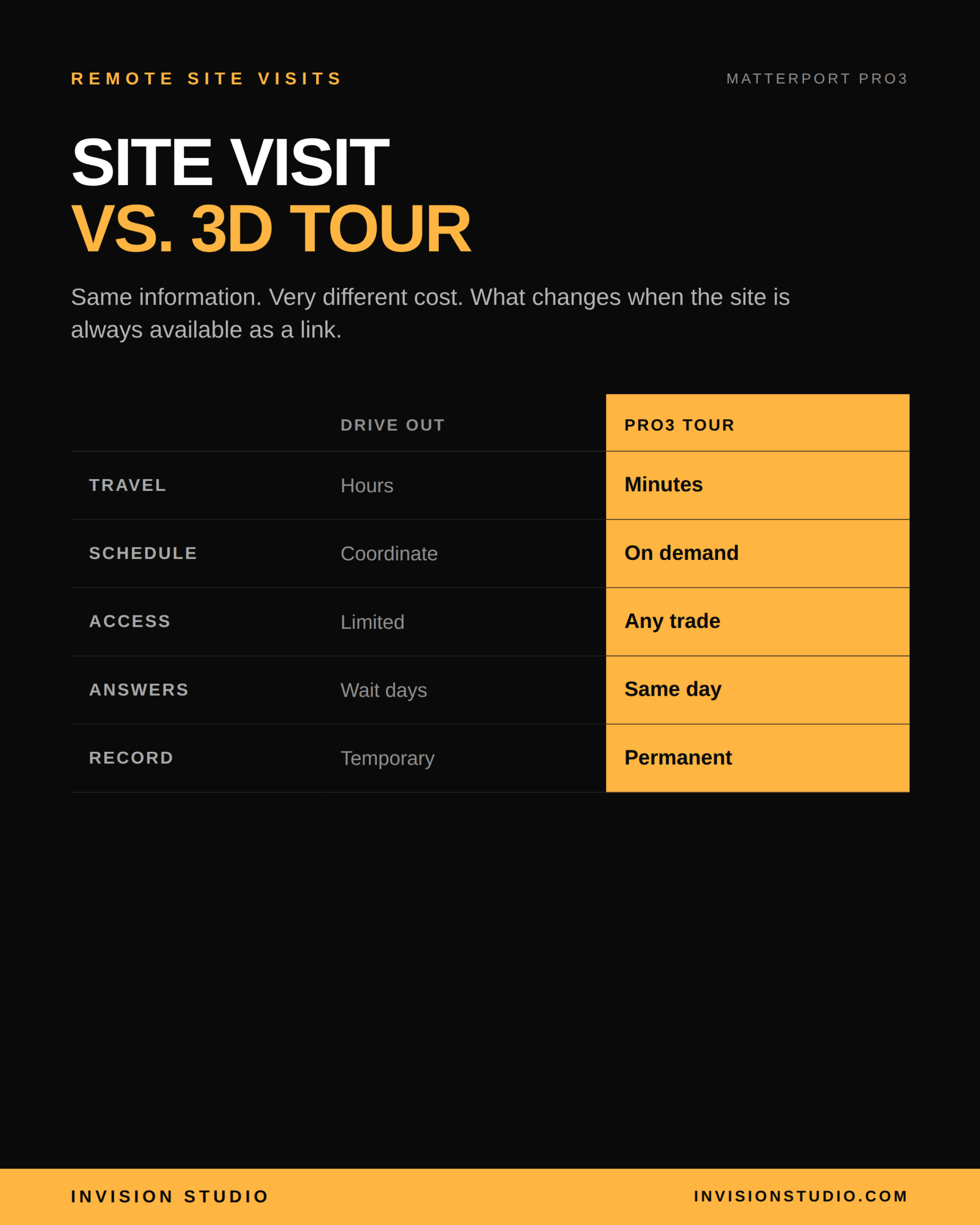
A remote site visit is any review of site conditions conducted without traveling to the site. Traditionally that meant a video call with a superintendent holding a phone — trading a plane ticket for a shaky camera and a lot of “can you tilt down?” A Matterport tour replaces the improvisation with a complete, dated, measurable walkthrough anyone can navigate alone.
It covers condition verification, progress confirmation, clearance checks, and trade coordination. It does not replace inspections that require a licensed professional on site, destructive testing, or judgment calls that depend on touch.
Where RFIs and change orders come from
Ambiguity
The drawing does not match the site, or a detail was resolved in a conversation nobody recorded. The RFI is paperwork catching up to reality.
Timing
By the time someone visits to confirm, the condition has been covered or changed. The answer must be rebuilt from memory and selective photos — which is how a clarification becomes a change order.
Distance
The person who can answer is in another city; the person who can see it cannot approve it. Every day that gap stays open is a day the schedule absorbs.
A 3D capture addresses all three: the condition is recorded in full, on a known date, and the person with authority can inspect it without a flight.
How a 3D tour shortens the RFI loop
- Capture on a schedule. Weekly or milestone scans keep the model on a known state rather than “sometime last month.”
- Pin the question to the location. A note or tag in the model carries the exact position, surrounding context, and photo — no more “north wall, near the sleeve.”
- Answer with a measurement. Measurement mode lets the architect or owner rep check the dimension instead of requesting a site verification; Matterport notes teams using in-model measurement to confirm ADA counter heights without returning.
- Close the loop in place. Resolve the item, record the decision, and keep it attached to the location for closeout.
B.R. & Co., which Matterport documents capturing job sites weekly, estimates project managers resolve about 75% of issues independently, saving roughly a day per milestone. Gilbane, capturing at each phase, reports saving roughly 25% to 30% in time and money and more than 1,000 hours in site travel. Both come from the same mechanism: the site is available without the trip.
RFI workflow, with and without
| Step | Without a 3D record | With a Pro3 tour |
|---|---|---|
| Question raised | Email with a partial photo | Note pinned at the exact location |
| Context | Super walks back out with a phone | Reviewer walks the tour from a desk |
| Dimension | Return trip with a tape | Measured in the model |
| Decision | Waits for a visit or meeting | Same day, often same hour |
| Record | Buried in a thread | Attached to the location |
| Change order risk | Rises each day work continues | Falls before mobilization |
Draw inspections and remote owners
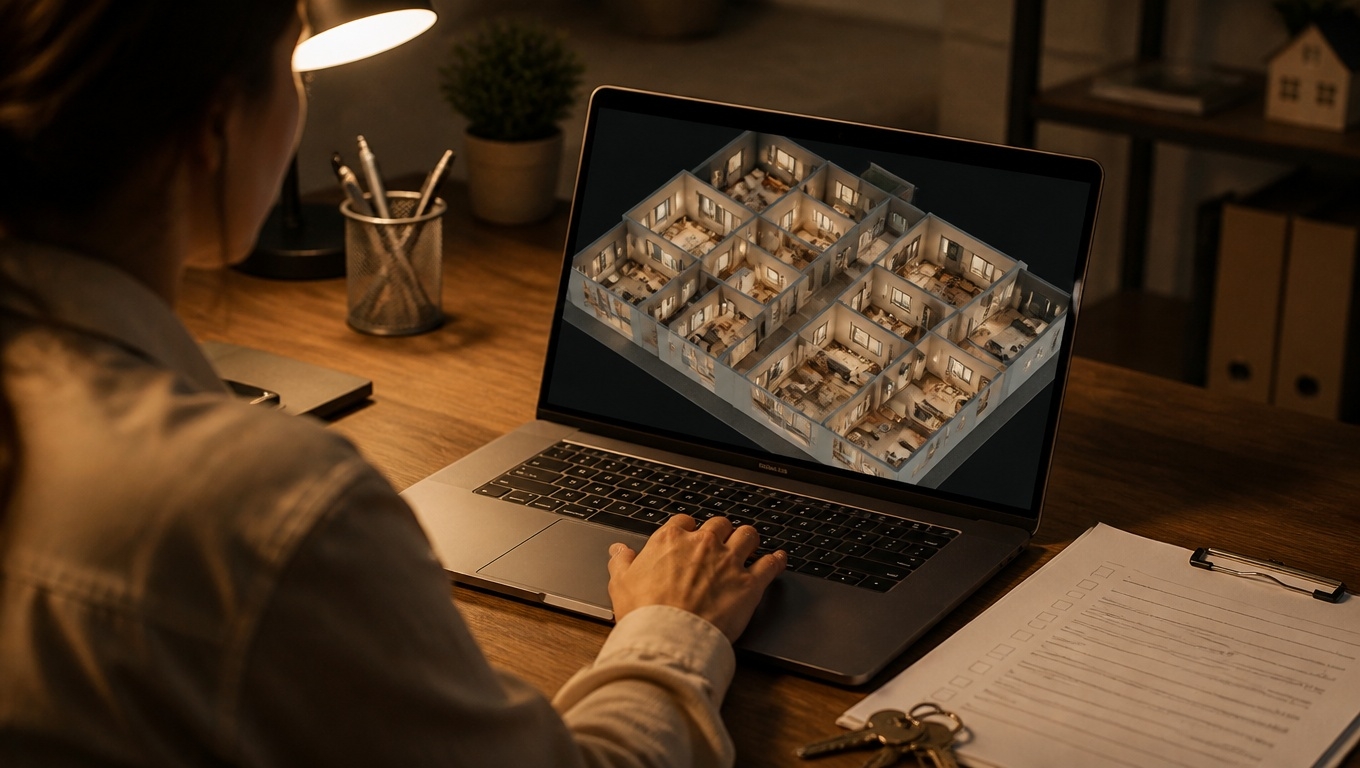
Draw requests are a documentation problem disguised as a finance problem: lenders are asked to release funds against progress they cannot see, described by the party requesting the money. A dated capture lets them verify percent complete, installed finishes, and stored materials from their own desk.
The bigger gain is cadence. An owner who can walk the project weekly asks better questions and raises fewer emergencies. Our Matterport 3D tour photographers recommend scheduling the owner’s review the same day each week, right after the scan is delivered, so the conversation is about decisions instead of catching up.
How often to scan
- Weekly or biweekly on active commercial and multifamily work, where trades overlap and conditions change fast.
- At milestones — framing, rough-in, drywall, finish, turnover — on custom residential, where the critical moments are fewer but more consequential.
- Event-driven after a change order, weather event, or dispute.
Between milestones, scanning only the affected area is enough. New captures merge into the existing tour, so you build one continuous record instead of a stack of unrelated links — which is what makes the closeout package useful rather than decorative.
Stop paying for site visits you could answer from a link
Invision Studio captures new builds with the Matterport Pro3 on whatever cadence your project needs — weekly, milestone-based, or event-driven.
Frequently asked questions
Can a 3D tour really reduce RFIs?
Both reduce and document. Many questions are answered by walking the space, and the ones that remain get a faster response because every reviewer has the same context and can measure without a trip.
Is a Matterport scan accurate enough for construction verification?
The Pro3 is rated at approximately ±20 mm at 10 m — suitable for as-built documentation, clearance checks, and BIM validation. It is not a substitute for survey-grade control where the contract requires it.
Who can access the tour, and can we limit what trades see?
Access runs through share links and permissions, and separate views can be created for owners, trades, and internal teams so sensitive areas and commercial information stay restricted.
Related reading: progress documentation · Matterport for engineers · move-in and move-out documentation